Culture Crawl 894 “Can I Bring My Kazoo?”

Jessica Altfillisch, executive director of Cedar Rapids’ Harmony School of Music, is back again to announce an exciting line up for this year’s Community Music Day. An instrument petting zoo, a music and mental health panel with music therapists from the University of Iowa, and an epic mixed ensemble performance of “Ode to Joy” led by Orchestra Iowa’s Tim Hankewich, are among only a few of the many performances and activities to take part of on this celebratory day.

Saturday, March 2, 10am-3:30pm @ CR Public Library Downtown. Free Admission.

For more information visit www.harmonycr.org

Subscribe to The Culture Crawl at www.kcck.org/culture or search “Culture Crawl” in your favorite podcast player. Listen Live at 10:30am most weekdays on Iowa’s Jazz station. 88.3 FM or www.kcck.org/listen.


News Digest 2-27-24

President Biden is optimistic about prospects for a ceasefire in Gaza…a bill to raise beginning teacher pay receives bipartisan approval from an Iowa House committee.

Soundtrack to the Struggle: Billie Holiday’s “Strange Fruit”

Early 1939. The lights go down at New York’s Cafe Society. The waiters hush the drinking audience, a single small spotlight shines on her face. And Billy Holiday begins to sing. “Southern trees, bears strange fruit blood on the leaves, blood at the root.” The song ends, and the spotlight goes out. Billy leaves the stage, the room is silent until one patron, then another, then finally the entire room begins to applaud. They rise for a standing ovation, but Billy doesn’t return for encores or vows.

Billy would repeat this performance many times in her last two decades, albeit only in clubs that would tolerate such a song. As with all forms of protest, Strange Fruit met with resistance. Columbia record refused to record it. So, she went to an independent label. It took months for radio stations to muster the courage to play it.

But Strange Fruit eventually grew to become more than an anthem on the horrors of torture and lynching in Jim Crow America. Leonard Feather hailed it as the first significant protest in words and music, “the first unmuted cry against racism,” Stud Turkels proclaimed it “a declaration of war. The beginning of the civil rights movement.” First sung 16 years before Rosa parks refused to yield her seat on a Montgomery Alabama bus. And as one Southern civil rights worker stated , “If Billy Holiday didn’t light the fuse, she unquestionably fed the flame.”

This episode of “Soundtrack to the Struggle” was written and produced by Ron Adkins. Executive Producers Dennis Green and George Dorman. Hosted by Hollis Monroe. 

News Digest 2-26-24

Nikki Haley vows to continue her campaign despite her latest loss in a GOP primary…Governor Reynolds used an assessment with a very small sample size to justify proposed changes in Iowa AEAs.

Clean Up Your Act 2-26-24

A new book – Zero Carbon Industry – calls for decarbonizing industry to reduce greenhouse gas emissions.

Soundtrack to the Struggle: Louis Armstrong – Caught Between Two Worlds

It’s 1925, and Louis Armstrong hits the music scene with a splash. With trumpet in hand and a wonderfully unique voice, he took on popular songs and stretched the boundaries of their rhythms and melodies so profoundly that American music hasn’t been the same since. Indeed, Louis Armstrong was America’s first “pop star,” whose appeal ignored the demographics of race in America.

Armstrong’s presence greatly impacted the African-American community. As Charles Black, a lawyer who participated in the 1954 Brown vs. Board of Education case and who grew up in racist, anti-black Texas in the 1930’s, notes: “He (Louis Armstrong) was the first genius I had ever seen. It is impossible to overstate the significance of a sixteen-year-old southern boy seeing genius, for the first time, in a black. We literally never saw a black then in anything but a servant’s capacity.”

For many years, however, “the Father of Jazz” kept silent on race issues. He never marched or made appearances with civil rights leaders. When criticized for not taking any public stand, Armstrong would simply reply, “I don’t get involved in politics. I just blow my horn.”

To many whites, Armstrong, with his trademark handkerchief, big smile, and down-home demeanor, represented something less threatening to the status quo. Sadly, this perception turned many black Americans against him. Criticized by activists and black musicians for playing into an “Uncle Tom” stereotype, Louis Armstrong, however, had his own subtle way of addressing racial issues. In 1929, he recorded Fats Waller’s “(What Did I Do To Be So) Black and Blue?” – a song from the musical Hot Chocolates. The powerful lyrics include the phrase: My only sin/Is in my skin/What did I do/To be so black and blue? Out of the context of the show and sung by a black performer in that period, these words were a risky and weighty commentary. Armstrong carefully placed its performance at the end of his concerts for best effect.

It was September 1957 when Armstrong did speak publicly about race relations in America. The country’s attention was on Little Rock, Arkansas, where Governor Orval Faubus and local segregationists defied a Supreme Court ruling desegregating the city’s Central High School. In an interview, Louis said, “It’s getting almost so bad a colored man hasn’t got any country.” President Dwight Eisenhower, he charged, was “two faced,” and had “no guts.” As for Faubus, Armstrong called him an “uneducated plow boy.”

This episode of “Soundtrack to the Struggle” was written by Hollis Monroe. Produced by Ron Adkins. Executive Producers Dennis Green and George Dorman. Hosted by Hollis Monroe.

This Week In Jazz February 25 thru February March 2


Hey, Jazz fans! Be sure to tune in this week as we celebrate the birthdays of saxmen Flip Phillips, Eddie “Lockjaw” Davis, Dexter Gordon and Richie Cole, singers Mildred Bailey Dinah Shore and Roseanna Vitro, bandleaders Glenn Miller and Jimmy Dorsey, bassist Nilsson Matta and more. We’ll also mark the recording anniversaries of Duke Ellington’s “Ellington Uptown” (1952), Grant Green’s “Born to Be Blue” (1962), Keith Jarrett’s “Treasure Island” (1974), Chet Baker’s “I Remember You” (1985), Abbey Lincoln, feat. Stan Getz’ “You Gotta Pay the Band” (1991), Richie Cole’s “Latin Lover” (2017) and many others, Mondays thru Fridays at noon on Jazz Masters on Jazz 88.3 KCCK.   


Special Programs February 26 thru March 3

The ClownJazz Corner of the World with host Craig Kessler
Mondays at 6:00pm

The Compositions of Charles Mingus

Craig surveys some of the more remarkable compositions of the great Charles Mingus, focusing mostly on his work from the 1950s into the 1970s!


The Wednesday Night Special

Wednesdays at 6:00pm

Goose Town at Jazz Under the Stars

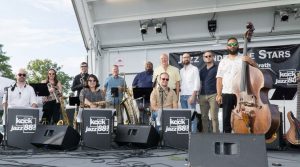
Goose Town lit up Jazz Under the Stars on a hot August in 2017. Made up of graduates of the U of I and Northern Iowa jazz programs, this 8-piece put their killer horn section out front for a night of funk, soul, jazz, and groove.


Elmo Hope Trio - WikipediaJazz Night in America with host Christian McBride

Thursdays at 11:00pm

The Legacy of Elmo Hope

Host Christian McBride celebrates the legacy of Elmo Hope, a giant of jazz piano who never got his due. He influenced some of the most groundbreaking artists of the genre, Bud Powell and Thelonious Monk. Not only was he their best friend, but he’s also credited for pushing them to find their creative voice.


Jazz Corner of the World with host Craig Kessler

Saturdays from 12 noon to 4:00pm

Bassist Ron Carter in the 1960’s

Join host Craig Kessler as he explores the music of Ron Carter. We’ll hear Carter with Miles Davis, Eric Dolphy, Jaki Byard and Don Ellis and many others.


KCCK’s Midnight CD

Every Night at Midnight

Each night, KCCK lets you hear a new CD played start-to-finish.

Reverence: A Tribute to Stephane Grappelli & Oscar Peterson by Jason Anick & Matt DeChamplain on Monday; And So It Goes by The Clayton-Hamilton Jazz Orchestra on Tuesday; With Just a Word by Diego Rivera on Wednesday; Flying Colors by the Gary Urwin Jazz Orchestra & Friends on Thursday; Side Hustle by One Dime Band on Friday; Buckle Up! by Brad “Guitar” Watson on Saturday; Lotta Livin’ by Betty Bryant on Sunday.