Special Programs for February 14 thru February 20

Jazz Corner of the World Encore  

Mondays at 6:00 PM

West Coast Jazz #4    

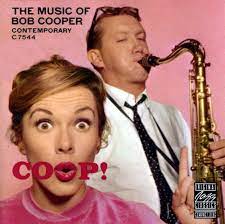
Join host Craig Kessler for his fourth and final “West Coast Jazz” presentation, as he takes a closer listen to more of the important jazz artists and arrangers. We’ll hear great material from Bud Shank, Bob Cooper, Russ Garcia, Bill Holman, and several other delights!


The Wednesday Night Special

Wednesdays at 6:00 PM

Shade of Blue at Jazz Under the Stars

Shade of Blue have been a fixture of Eastern Iowa’s music scene for over three decades. Rooted in the blues, these Iowa Rock & Roll Hall of Fame inductees have evolved into one of the hottest sources of soul, jazz, funk, and groove. They’ve opened for the Neville Brothers, Koko Taylor, and George Clinton, and they headlined a rockin’ night at Jazz Under the Stars.


Jazz Night in America

Thursdays at 11:00 PM

The Transformation Suite

Host Christian McBride spotlights young pianist, composer, and activist Samora Pinderhughes. We’ll hear the Berkeley, California debut of his groundbreaking Transformation Suite – a mix of music, poetry and a call to action.  


Jazz Corner of the World 
Saturdays at 12:00 Noon

Black Jazz Record Label, Part 3     

Host Craig Kessler presents more terrific material from Black Jazz Records – the Oakland-based, African-American owned and operated jazz label from the 1970s. We’ll hear underrated and obscure material from Kellee Patterson, Roland Haynes, Henry Franklin, Walter Bishop Jr., Rudolph Johnson, Gene Russell, and more. Tune in to hear some very important and influential jazz music.


KCCK’s Midnight CD

Every Night at Midnight

Each night, KCCK gives you the chance to hear a new CD played start-to-finish.

Ira: the Tribute Album by the Blue Road Records Band on Monday; Each Step by Nathan Borton on Tuesday; Another Time, Another Place by the New Standard Quintet on Wednesday; Force of Nature by Deanna Witkowski on Thursday; Booze, Blues & Southern Grooves by Reddog & Friends on Friday; Highs & Lows by Bernard Allison on Saturday; Girl Talk by Sasha Dobson on Sunday
New Music Monday for February 14, 2022

   Listen to this week’s playlist on YouTube and Spotify
 Pianist Bill O’Connell is a genuine triple-threat in jazz, equally well-known as a composer, arranger and instrumentalist. He honed his craft carefully from his days with Mongo Santamaria in the ‘70s, his gigs with Chet Baker, Gato Barbieri, Sonny Rollins and others, and his long-time associations with Jerry Gonzalez’s Fort Apache Band and the Latin jazz flautist Dave Valentin. His new CD, “A Change is Gonna Come,” features seven remarkable works by O’Connell, a four-time recipient of the Jazz Writer of the Year award from SESAC, along with a tune by ‘Trane and the title track by Sam Cooke.


     Jazz vocalist Giacomo Gates is blessed with a smooth and supremely expressive baritone voice and an all-inclusive musicality which encompasses a hipster-like  coolness, a smattering of vocalese, an Eckstine-like seductiveness, the story telling ability of a griot, a firm footing in the blues and a sense of swing which is second to none. His performances can be quiet and full of insight or be ebullient and joyful. Whatever style Gates may offer, he infuses the music with an understated humor, wry cultural and social implications and an impish delight in surprising his listeners. His new recording, “You,” includes 18 songs everybody knows and loves, arranged with creativity and wit.


Also this week, bassist Boris Kozlov sets an ambitious course for his Posi-Tone Records debut, “First Things First,” as saxophonist Donnie McCaslin, vibraphonist Behn Gillece, keyboardist Art Hirahara and drummer Rudy Royston keep moving freely over the solid harmonic foundation provided by Kozlov’s playing and leadership;


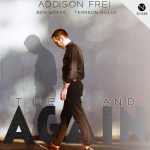
 Harlem-based pianist/composer Addison Frei’s trio album, “Time and Again,” featured legendary bassist Ben Wolfe and drummer sensation Terreon Gully;


    and Knoxville, Tennessee-based drummer and composer Kenneth Brown, the son of visionary jazz pianist Donald Brown, unveils “Love People.”


Culture Crawl 688 “Don’t Toss the Wine Bottles”

The Cedar Rapids Concert Chorale has two big events in the coming weeks. Their sole fundraiser of the year, the Mardi Gras Gala, will be at the Czech Museum Feb. 26, and the Chorale pays tribute to the many composers who call, or have called Cedar Rapids home, in their next concert, March 5 at First Lutheran Church.

Tickets, and information on how to join the Chorale, which is open to any interested singer, at www.crchorale.org.

Talking Pictures 2-9-22

Reacher (Amazon Prime) and House of Gucci (2021)…plus an Oscar nomination discussion…with Hollis Monroe, Phil Brown and Scott Chrisman. 

Soundtrack to the Struggle: Cab and Minnie

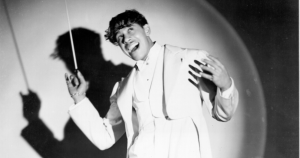
Cab Calloway’s subtle but indelible influence on American culture began the moment he forgot the chorus to his own signature song. Picture the scene: The club is packed. Dancers fill the floor. Calloway steps to the mic and begins that new song he’s been dying to sing. He reaches the chorus. Something catches his eye. And he can’t remember what comes next. Always the consummate showman, he improvises with some scat. The crowd joins in. The rest is history.

That happy accident forever changed “Minnie the Moocher,” and introduced a piece of Black history to future generations. The “call-and-response,” an intrinsic element of African culture, was brought to America during the slave trade. Field workers incorporated call-and-response into their work songs, to set th

e pace of labor, but also as covert communication. It became a potent form of resistance, picked up again during the marches of the Civil Rights movement.

Of great pride to Calloway was “Minnie the Moocher’s” legacy for breaking the color barrier. Over a million copies were sold upon release and was played on both black and white radio stations. The story of a down-and-out opium addict, it seems, has universal appeal.

Calloway led what was arguably the most popular big band of the Harlem Renaissance and into the Swing Era. He replaced Duke Ellington as the headliner of the Cotton Club. The fact that his all-Black orchestra could play the Cotton Club but not enter as guests was not lost on him. As if in response, he took his band on the road, leading a successful all-Black revue through the deep South.

“Soundtrack to the Struggle” is written and produced by Ron Adkins. Executive Producer is Dennis Green. Hosted by Hollis Monroe.

Soundtrack to the Struggle: “Big Jay and The Photo”

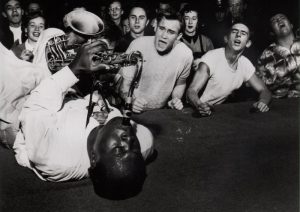
It’s 1951 Los Angeles, and photographer Bob Willoughby works in his darkroom, listening to the radio. The disc jockey promotes a jazz concert that night at the Olympic arena. The concert starts at midnight. Intrigued, Willoughby packs his camera and heads for the show. What he finds there, and what he captures on film, become iconic images of the power of jazz. Look a little closer to the photos, and another, deeper story unfolds.

Willoughby finds the show in full swing. Hundreds of young fans crowd the stage. They are enraptured. Saxman Big Jay

 McNeely, famous for his infectious energy, has them whipped into a near frenzy. Caught up in the moment, Willoughby jumps on stage and shoots frame after frame. His most famous image is of McNeely, lying on his back at the edge of the stage, drenched in sweat, wailing on the sax while the kids scream.

The energy emanating from that photograph is palpable. But it is also a telling reflection of the times. Look deeper. You’ll notice that all those screaming kids are white. There isn’t a person of color to be seen. And toward the back, a white policemen patrols the crowd. His expression is sober. His eyes are wary of McNeely’s performance and the young people’s reaction.

As one jazz writer commented at the time, “Music may be colorblind, but society in the 1950’s sure wasn’t.”

“Soundtrack to the Struggle” is written and produced by Ron Adkins. Executive Producer is Dennis Green. Hosted by Hollis Monroe.

Soundtrack to the Struggle – Nina Simone

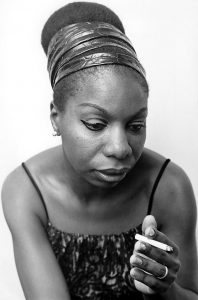
Nina Simone’s career in activism began in 1964, when her songs openly addressed racial inequality prevalent in the United States. She recorded the still-controversial “Mississippi Goddam,” her respon

se to the murder of Medgar Evers and the bombing of Birmingham’s 16th Street Baptist Church. That song, and others like “Old Jim Crow,” she said, were her first civil rights songs. They were a direct challenge to the status quo in race relations and raised her voice in the fight for equality.

Response to her music was, predictably, angry. She was boycotted in many Southern states. One Carolina radio station smashed promotional copies of her singles and sent the pieces back to the re

cord label. Undaunted, the message of equality became Simone’s standard repertoire. Civil rights leaders frequently asked Simone to perform and speak at gatherings, such as the Selma to Montgomery Marches. She was invited to attend the historic meeting with Attorney General Robert Kennedy, along with her friend, playwright Lorraine Hansberry.

Nina Simone’s personality reflected her politics. She was outspoken and possessed an often volcanic temper. She sided closer to Malcolm X’s more militant philosophies than to Martin Luther King’s non-violent approach. She advocated armed revolution, if necessary, and the formation of a separate state. And though her songs, she said, were written “in a rush of fury, hatred, and determination,” she believed that, ultimately, all races were equal and could someday peacefully coexist.

“Soundtrack to the Struggle” is written and produced by Ron Adkins. Executive Producer is Dennis Green. Hosted by Hollis Monroe.

Soundtrack to the Struggle “Work Song”

The work song has existed since the dawn of recorded history. Field hands, boatmen, railroad gangs, and even cowboys used the work song to lift spirits and maintain the pace of labor. During the American era of slavery, the work song evolved into something far greater. It became a powerful means of communication, resistance, and catharsis. Through call-and-response, field workers carried on a dialogue under the noses of their foremen. News was passed. Common complaints were shared. Uprisings were planned.

Improvisation was a common element in these dialogues, as were the field hollers and moans. As slaves converted to Christianity, their songs included appeals for divine deliverance. Over time, the work song included odes to the act of work itself – be it hard physical labor, the tribulations of a love affair, or the tortures of a tyrannical boss. This is the fertile ground where blues, gospel, and jazz took root.

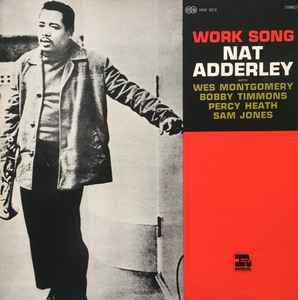
Trumpeter Nat Adderley understood the depth of his musical roots, and in 1960 wrote his own “Work Song.” All the traditional tropes are there – the call-and-response, the bemoaning of labor, the improvisation. Oscar Brown, Jr. added poignant lyrics, making this “Work Song” a testament to the struggles of the past and the labor still to be done.  

“Soundtrack to the Struggle” is written and produced by Ron Adkins. Executive Producer is Dennis Green. Hosted by Hollis Monroe.