CORRIDOR JAZZ PROJECT RETURNS TO THE PARAMOUNT
Three new schools join for the progam’s 15th year
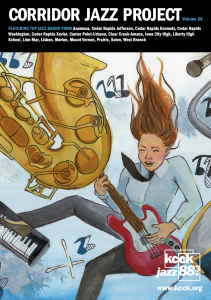 Three new schools join The Corridor Jazz Project as the program celebrates its fifteenth year at a massive concert March 8th at the Paramount Theatre, Cedar Rapids. The concert will be presented in two “sessions,” to accommodate those who are not able to attend the entire concert. Ticket holders can attend one or both sessions for the same $15 price, and also come and go if they need a break.
5:30 Session
- 5:35 Cedar Rapids Washington High School Revolutionists, featuring Joe Perea
- 5:50 West Branch Jazz Ensemble, featuring Steve Shanley
- 6:05 Lisbon High School Jazz Band, featuring Joseph Schnoebelen
- 6:20 Clear Creek-Amana Jazz Ensemble, featuring John Carlson
- 6:35 Liberty High School Jazz Ensemble, featuring Jim Dreier
- 6:50 Cedar Rapids Xavier High School Jazz Band One, featuring Luke Sanders
- 7:05 City High School Jazz Ensemble, featuring Crystal Rebone
- 7:20 Solon High School Jazz Orchestra, featuring Saul Lubaroff
7:30 Session
- 7:35 Cedar Rapids Kennedy High School Jazz Band One, featuring Toni Lefebvre
- 7:50 Linn-Mar High School Colton Center Jazz Ensemble, featuring Simon Harding
- 8:05 Cedar Rapids Jefferson High School Jazz Ensemble, featuring Peter Hart
- 8:20 Center Point-Urbana Jazz Band, featuring Lynne Hart
- 8:35 Mount Vernon High School Swingin’ STANGS, featuring Tim Crumley
- 8:50 Anamosa High School Jazz I, featuring Kevin Boehnke
- 9:05 Marion High School Jazz Band One, featuring Peter Hart
- 9:20 Prairie High School Jazz One, featuring Anthony Williams
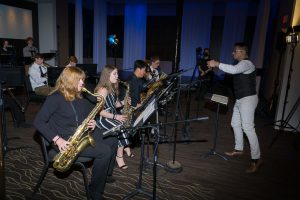
The Corridor Jazz Project is a jazz education and mentoring program for jazz band students, created by Jazz 88.3 KCCK, the public radio station operated by Kirkwood Community College. The Corridor Jazz Project is one of very few school Fine Arts events which found a way to continue during the pandemic pause.
“In 2020, The Corridor Jazz Concert was the last high school jazz event held in the entire state, days before the COVID shutdown,” says Dennis Green, KCCK general manager. “Last year, we produced an online video concert in lieu of an in-person event, traveling to each school and recording them in a safe and socially-distanced fashion. We felt very fortunate that in a year when so many programs were cancelled, the students were still able to look forward to having the Corridor Jazz Project.”
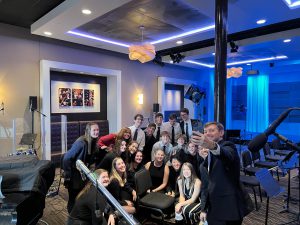 In addition to returning as an in-person event, two things make this year’s program special. Three new schools participate for the first time: Anamosa, Clear Creek-Amana, and West Branch. And after the success of 2021’s video recordings, KCCK will release video recordings of each band on DVD instead of an audio CD.
The concert will be presented as a part of the Cedar Rapids Community Concert Association (CRCCA) season, returning to the Paramount for the first time since 2019. Ticket information is available at www.crcommunityconcert.org, and tickets will be sold at the door.
The Corridor Jazz Project matches a high school jazz band with a professional jazz player, and records each performance using a professional audio and video recording team. Corridor Jazz DVDs are made available to each school to sell and keep the proceeds. They can also be ordered online at www.kcck.org.
Support for the Corridor Jazz Project comes from MidWestOne Bank, the Cedar Rapids Community Concert Association, Orchestra Iowa, Hills Bank, The Strauss Family Fund for Jazz Education, The Greater Cedar Rapids Community Foundation, Kirkwood Community College, and West Music.

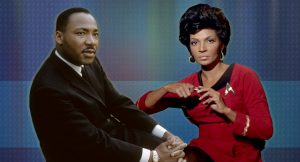 It’s 1967, and singer and actress Nichelle Nichols attends a fund-raiser for the NAACP. A man approaches and says, “Ms. Nichols, I’m your greatest fan.” That fan was Dr. Martin Luther King, Jr. During their chat, Nichols confides her plans to leave her current TV gig for a career on Broadway. King was mortified. “You can’t leave Star Trek,” he said. “You’re a part of history. You aren’t cast as a servant. You play a Black woman in authority. You’re a role model for women and Negroes everywhere.” Nichols took Dr. King’s words to heart, and stayed with the show. She made TV history again when, as part of an episode, she took part in television’s first interracial kiss.
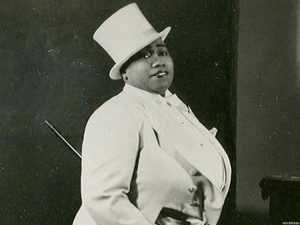 It’s Prohibition-era Harlem, and Gladys Bentley is at the piano at Harry Hansberry’s Clam House, one of the biggest gay speakeasies in New York. Dressed in her signature tuxedo and top hat, she sings bawdy lyrics to popular songs. Her voice is deep and growling, and she flirts with the women in the audience.
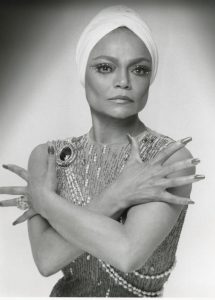 Eartha Kitt was never afraid to use her distinctive voice. Born on a South Carolina cotton plantation, Eartha Mae Keith grew to record the standards, “Let’s Do It,” and “C’est Si Bon.” She was fluent in French, spoke four other languages, and sang in 11. She recorded, sang in nightclubs, and appeared in films, television, and Broadway.