Big Mo Pod Show 052 – “Jolly Collaboration”

Welcome back to the Pod show! This week’s episode features a track list of songs that’re mostly collaborations between multiple artists, and your hosts analyze each artist in a double feature discussion. Check out the episode to learn about them all! Songs featured in the episode: 

  1. Heavy Drunk, Watermelon Slim – “New Wine” 
  2. Sue Foley, Janiva Magness – “Holes” 
  3. The Dirty Dozen Brass Band – “Santa Cruz” 
  4. Big Al and the Heavyweights – “Blues Power” 
  5. Big Bill Broonzy – “Baby Please Don’t Go” 

Listen to ‘da Friday Blues with Big Mo each week at 6pm, and catch the podcast for a behind the scenes look at the show!

KCCK’s Featured Album for March 2025

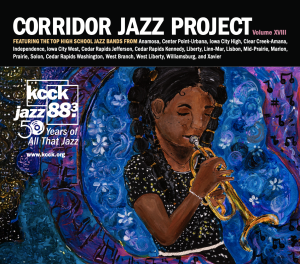
2025 Corridor Jazz Project album coverThe KCCK Featured Album for March is KCCK’s Corridor Jazz Project Volume 18, featuring the outstanding students from a record twenty-one Eastern Iowa high school jazz bands. Each band is paired up with a professional guest artist who mentors the students during rehearsals and professional recording sessions. The experience culminates with concerts featuring the bands and their special guests. It’s all part of KCCK’s educational outreach program. Purchase 

Culture Crawl 1034 “High Tolerance for Accordion”

The Swampland Jewels team up with the Dandelion Stompers for a Fat Tuesday concert March 4 at Wildwood Saloon in Iowa City. Forrest Heusinkfeld and Nate Basinger talk about the band’s “Gulf Coast” sound and reveals plans for an album later this year. Advance tickets at www.wildwoodsaloon.com.

Subscribe to The Culture Crawl at kcck.org/culture or search “Culture Crawl” in your favorite podcast player. Listen Live at 10:30am most weekdays on Iowa’s Jazz station. 88.3 FM or kcck.org/listen.

Soundtrack to the Struggle: A Great Day in Harlem

It’s 1958, and freelance photographer Art Kane is commissioned by Esquire magazine to shoot photos of jazz musicians for their upcoming “Golden Age of Jazz” feature. An avid music fan, Kane jumps at the chance. He puts the word out: Be at 17 126th St., Harlem, at 10 in the morning. His editors voiced concern. By 1958, the center of jazz had shifted to 52nd St. in Midtown Manhattan. And 10am? Would anyone show up that early?

57 of jazz’s royalty gathered on the front steps of the Brownstone, dressed in suit and tie and evening gowns. There was Count Basie, Dizzy Gillespie, and Marian McPartland. Lester Young, Thelonious Monk, and Charles Mingus. Mary Lou Williams and Coleman Hawkins.

Many in the shot noted the electricity of the moment. It didn’t matter where Kane took the picture. Harlem was always home. Just being back for a couple of hours, all together – black and white, reminded them of the community they had built, and the history they had made.

Sonny Rollins, the sole surviving artist in that photograph, told the New York Times in 2024, “A Great Day in Harlem’s” significance lives on. In 1958, racism and segregation (especially in the arts) was pervasive. Rollins said, “It just seemed like we weren’t appreciated, mainly because jazz was a Black art. It think that picture humanized a lot of the myth of what people thought jazz was.” 

Culture Crawl 1033 “Cardboard Box Violin”

The Avita Duo is comprised of the mother-daughter team of Ksenia Nosikova, chair of the piano department at the University of Iowa, and Katya Moeller, currently studying at Juilliard.

The duo performs March 4 at Opus Concert Cafe prior to their first ever New York performance later in March. Tickets for the Opus show at www.artsiowa.com. Follow the Avita Duo at www.avitaduo.com.

Subscribe to The Culture Crawl at kcck.org/culture or search “Culture Crawl” in your favorite podcast player. Listen Live at 10:30am most weekdays on Iowa’s Jazz station. 88.3 FM or kcck.org/listen.

Soundtrack to the Struggle: Ella Arrested

It’s 1955, and Ella Fitzgerald and her band take a break between sets at the Houston Music Hall. In her dressing room, Ella and her assistant, Georgiana Henry, chat and drink coffee, while over in the corner, Dizzy Gillespie and Illinois Jacquet shoot a quick game of craps. The door suddenly bursts open and five plainclothes policemen rush in, guns drawn.

Producer and agent Norman Granz, a staunch integrationist and activist, faced them down. He followed a policeman into the bathroom, suspecting he might be planting drugs. “I’m watching you,” said Granz. The cop shoved his gun into Granz’s stomach and growled, “I oughta kill you.”

The vice squad made their arrests and the entire troupe was taken to the police station, where reporters and photographers were already waiting. They were charged with illegal gambling, paid a fine, and were eventually released. Throughout the booking process, and much to their chagrin, police officers approached them for autographs. They were driven back to the Music Hall and performed their second set, to thunderous applause from the entire audience.

The story made headlines worldwide, skewering the Houston police for a blatantly racist, pre-planned publicity stunt to stop a desegregated show. The band’s subsequent gigs sold out across the country. And in a final twist, they returned to Houston a year later and played to a standing-room-only, integrated audience.

Talking Pictures 2-26-25

“The Monkey” (2025) and “Captain America: Brave New World” (2025) with Hollis Monroe, Phil Brown and Scott Chrisman.

Soundtrack to the Struggle: Charlie Haden

It’s 1968, and the Democratic National Convention erupts into violence. Rejection of a plank
condemning the Vietnam War sparks protests on the streets of Chicago. Bassist Charlie Haden,
a vehement critic of the war, watches it all unfold. He is angry and disgusted, and he decide
that he must take action.

Haden forms the Liberation Music Orchestra, an ensemble of fellow activist-musicians,
including Carla Bley, Paul Motian, and Dewey Redman. Their repertoire includes “Circus ’68
’69,” a criticism of the convention violence. Haden considered jazz the “music of rebellion.” It
was his mission, he thought, to challenge the world through his jazz.

At a 1971 gig in Portugal, then under a fascist dictatorship, Haden dedicated his “Song For Che
(Guevara)” to revolutionaries in Portuguese-controlled African nations. He was arrested by the
Portuguese secret police, interrogated, and jailed. Haden never denounced his stance against
racist colonialism and Western empire-building, declaring it the root of social problems in
America.

Said Haden, “I want an America worthy of the dreams of Martin Luther King, and the majesty of
the Statue of Liberty. I always dreamed of a world without cruelty and greed, of a humanity
with the same creative brilliance of our solar system. Haden dedicated his music to those who
“still dream of a society with compassion, deep creative intelligence, and a respect for the
preciousness of life.”