Soundtrack to the Struggle: Duke Ellington’s Grand Statement

January 23, 1943. Carnegie Hall. Duke Ellington and His Orchestra make their debut at the legendary venue. On the program is the premiere of Ellington’s new magnum opus – his three movement jazz symphony, “Black, Brown & Beige.” It is Ellington’s longest and most ambitious composition to date. Admittedly, the piece as a whole is under-rehearsed and rough in spots. But Duke is excited to use this stage-of-all-stages to make a grand statement on the Black condition.

He dubbed it, “a tonal parallel to the history of the Negro in America.” Within each movement, suites reflect components of the African-American experience, from slavery to Harlem to swing. Tympani portray the sounds of hard labor. Muted trumpets echo wails and work songs. There are spirituals and dance numbers. The work is rich and orchestral, but most assuredly jazz. Ellington makes sure his audience knows that jazz is America’s music – created by Black Americans.

Critical response to the Carnegie Hall performance is, at best, mixed. Discouraged by its tepid response, Ellington only performs “Black, Brown and Beige” once more before breaking it into pieces. Yet those pieces, like “Work Song,” and “Come Sunday,” collectively make the most powerful statement of all: We’ve come so far, but still have so far to go.

This episode of “Soundtrack to the Struggle” was written and produced by Ron Adkins. Executive Producers Dennis Green and George Dorman. Hosted by Hollis Monroe.

Talking Pictures 2-7-24

The Beekeeper (2024) and American Fiction (2023) with Hollis Monroe, Phil Brown and Scott Chrisman.

News Digest 2-7-24

The bipartisan border deal has collapsed in Congress…Iowa lawmakers continue to deal with transgender issues.

Soundtrack to the Struggle: “You’re Under Arrest” – Miles Davis Gets Political

It’s 1984, and Miles Davis is changing his musical course yet again. He’d exhausted his exploration of jazz fusion and now looked for a fresh perspective. The result was “You’re Under Arrest.” This album was intentionally controversial – from its garish cover art, to its confounding mix of in-your-face statements and sugary pop ballads. It was also Miles’s most overtly political record to date.

Miles Davis chose this time to go public with his long-held views on nuclear proliferation, racism, and especially, police intimidation. He had fallen victim to police brutality in 1959, when he was beaten and arrested by a white New York City cop. As he released “You’re Under Arrest,” Miles also lent his horn to the Sun City anti-apartheid movement, and to Amnesty International.

He had always been a supporter of the equality struggle and a vocal defender of Black culture. He believed that jazz was the purview of Black America, and that white musicians had co-opted their way into the art form. He was a staunch defender of the disenfranchised and openly contemptuous of the aura of white privilege. At a White House gathering, Nancy Reagan is said to have asked Davis, “What have you done to deserve being here?” Miles replied, “Well, I’ve changed the course of music five or six times. What have you done?”

“You’re under Arrest,” Miles’s latest course change, was initially met with a mixed, confused response. But, like the musician himself, the music and the causes he championed are multi-layered, difficult to define, and require study and contemplation.

This episode of “Soundtrack to the Struggle” was written and produced by Ron Adkins.

News Digest 2-6-24

A bipartisan border deal faces potential roadblocks in Congress…Governor Reynolds says she’ll send Iowa state troopers to the southern border for a third time.

Soundtrack to the Struggle: Ella and Marilyn’s Unlikely Friendship

Rumor has it that Marilyn Monroe’s vocal coach, very early in Monroe’s career, ordered her to buy all of Ella Fitzgerald’s records, and to listen to them 100 times in a row. This deep study of Fitzgerald’s singing made Monroe not only a pretty solid singer herself, but it brought about the beginning of a strange and beautiful friendship.

By the 1950’s, Ella Fitzgerald was jazz royalty. And yet, even she couldn’t sing in America’s biggest nightclubs. Bigotry kept her relegated to smaller venues, and forced her to enter through the kitchen. Even Fitzgerald’s agent, Norman Granz, who insisted that all his clients be treated equally, couldn’t get her on stage at some of the best jazz clubs.
One of those venues was Hollywood’s Mocambo Club. Clark Gable, Humphrey Bogart, and Lauren Bacall had reserved tables. But Ella wasn’t allowed through the door. That is, until Marilyn – now a superstar herself – made a phone call. “I told the owner to think of the publicity. I’d be there every night at the front table,” said Marilyn. And she did that very thing. She even brought Frank Sinatra along. “I owe Marilyn Monroe a real debt,” said Ella. “After that, I never had to play a small jazz club again.”

This episode of “Soundtrack to the Struggle” was written and produced by Ron Adkins.

Special Programs February 5 thru February 11

Jazz Corner of the World with host Craig Kessler
Mondays at 6:00pm

Blue Note 85th Anniversary Collection, Part 3

Craig plays more selections from the unusual and obscure side of Blue Note. This again will include bonus material from a 4-part course Craig is teaching on Blue Note Records for the University of Iowa Senior College.


The Wednesday Night Special

Wednesdays at 6:00pm

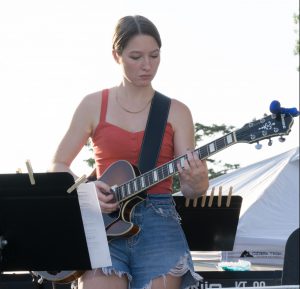
Young Artists at JUTS 2023

KCCK invited some of Iowa’s great young jazz talent to open each night of Jazz Under the Stars. Student groups the Ana Koch Quartet, Ship of Fools, the Harlan, Iowa Brass Combo, and the U of I’s Nexxus Brass led off our hot August nights in 2023.   


Donald Harrison: Free To BeJazz Night in America with host Christian McBride

Thursdays at 11:00pm

Donald Harrison in NOLA

Christian McBride shares stories from New Orleans saxophonist Donald Harrison Jr.’s upbringing, words from his mentee  — drummer Joe Dyson, and a performance on his home turf, recorded at the legendary Snug Harbor. 


Jazz Corner of the World with host Craig Kessler

Saturdays from 12 noon to 4:00pm

Blue Note 85th Anniversary Collection, Part 4

Craig wraps up his four-part listen to the unusual and obscure side of Blue Note. This again will include bonus material from the course Craig is teaching on Blue Note Records for the University of Iowa Senior College.


KCCK’s Midnight CD

Every Night at Midnight

Each night, KCCK lets you hear a new CD played start-to-finish.

Charles, Play! by Charles Chen on Monday; Blue Topaz by Peter Hand on Tuesday; Live at Dizzy’s Club: The Music of Elvin & McCoy by Gerald Cannon on Wednesday; Tell the Birds I Said Hello: The Music of Herbie Nichols by Ben Allison, Steve Cardinas, & Ted Nash on Thursday; The Love You Bleed by Danielle Nicole on Friday; Olustee by JJ Grey & Mofro on Saturday; Blues for the End of Time by Felix Lemerle on Sunday.

News Digest 2-5-24

Details of a bill that would pair border enforcement with aid for Ukraine have been released by the U.S. Senate…Republicans in the Iowa legislature try to figure out what to do with Gov. Reynolds’ AEA reform proposal.